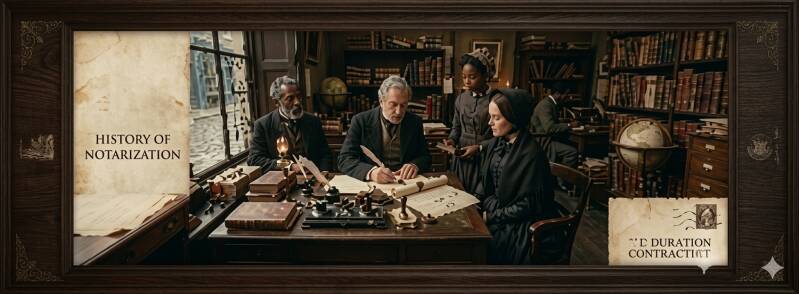
History of Notarization
Notaries have been around for centuries, first appearing in ancient Rome, where scribes known as 'notarii' recorded speeches and official acts. As societies grew more complex, the role evolved into a trusted witness to transactions and legal agreements. In medieval Europe, notaries became essential for authenticating contracts and preserving reliable records, especially when trade and property rights needed clear documentation. Over time different countries formalized the office, but the core idea an impartial witness who helps prevent fraud That tradition, carries on in the modern notary system today.
The History Behind the Documents
While the notary profession continued to develop, the ability to fully participate in the legal system was not equally available to everyone. For Black Americans, the history of documents, signatures, courts, and legal recognition carries a particularly important meaning.
During slavery, enslaved Black people were denied basic legal freedoms and were not treated as equal participants in the legal system. Even after some Black Americans gained their freedom, that freedom did not automatically mean equal rights.
In Maryland, free Black people faced laws that restricted their civil and political rights. In 1796, the Maryland General Assembly prohibited free Black people from testifying in certain freedom suits. In 1802, Black men were disenfranchised. Then, in 1805, Maryland established Certificates of Freedom and required free African Americans to record proof of their freedom with the county court. These certificates could include identifying details such as a person's age, height, complexion, hair, and distinguishing marks.
Imagine what it meant to have something as fundamental as your freedom documented by the courts. A piece of paper could become proof of who you were and whether the law recognized you as free.
Black women faced additional barriers as they fought for the ability to participate fully in civic, legal, educational, and professional life. The opportunities that many people may take for granted today were built over generations of perseverance, sacrifice, and change.
This history reminds us that documents are more than paper. A document can represent identity. It can represent ownership, freedom, family, opportunity, and a person's ability to have their rights recognized.
From Then to Now
Today, the role of a notary is centered on trust, integrity, responsibility, and impartial service. A notary may witness a signature on a document that represents something extremely important in a person's life.
For me, that history gives the profession an even deeper meaning.
To be a Black woman serving my community as a Maryland Notary Public is something I do with pride. I recognize that I am standing in a place that generations before me did not always have equal access to.
The history should not be forgotten. It should remind us how far we have come, while also reminding us of the importance of treating every person with dignity, fairness, and respect.
And from that history, I now share my personal story.
Personally, From Shaunte N Guy Notary Public
Personally, I believe history matters because it reminds us where we came from and helps us appreciate where we are today.
As a Black woman and Maryland Notary Public, I am proud to serve my community in a profession built on trust, integrity, and responsibility.
I often think about the generations of Black women who came before me — women who lived through times when opportunities, rights, and recognition were limited simply because of the color of their skin and because they were women.
Their strength, perseverance, and sacrifices are part of why I can stand where I am today.
When I sit down with a client and place my notary seal on an important document, I recognize that I am participating in a history much bigger than a signature. I am helping people document important moments in their lives, and I do not take that responsibility lightly.
I am proud of how far we have come, grateful for those who came before me, and honored to serve others today.
From me, your notary — I carry this history with pride, and I am honored to continue the tradition of serving my community with integrity, respect, and purpose. 𝓢𝓱𝓪𝓾𝓷𝓽𝓮 𝓝 𝓖𝓾𝔂
Shaunte N Guy
Maryland Notary Public
Equity Elite Notary Public.